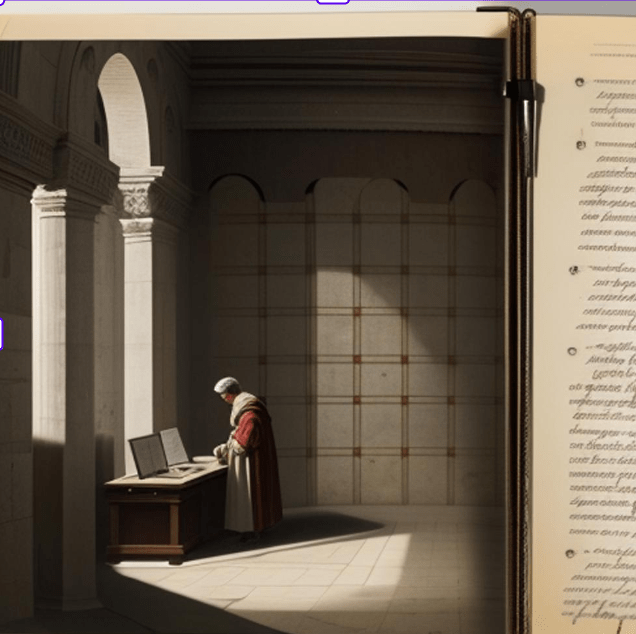
A letter of manumission, also known as a manumission document, was a legal document in ancient Rome that granted freedom to an enslaved person. The contents of such a letter would include the name of the enslaver (manumittor) this would be the person who currently owns the enslaved person and is granting them freedom.The name of the enslaved person being freed (manumittee) the letter would clearly identify the individual who is being granted freedom.A clear statement of manumission the letter would explicitly state that the enslaved person is being freed from slavery and is now a libertus (freedperson). The date of manumission the letter would specify the date on which the manumission takes effect. Witnesses the document would often include the names of witnesses present at the signing of the letter to confirm its legitimacy.The signature or seal of the manumittor the enslaver would sign or seal the letter to make it official.Any conditions or stipulations in some cases, the manumittor might include certain conditions for the manumission, such as requiring the freed person to work for them for a specific period or perform certain duties.
The exact format and content of manumission letters could vary depending on the time period and the individual circumstances of the manumission. Once completed, the letter would serve as legal proof of the formerly enslaved person’s new status as a freed person.
Here is a sample letter of manumission from ancient Rome:I, Gaius Iulius Rufus, do hereby declare that my slave, Marcus Valerius Fortunatus, is henceforth a free man.
Having served me faithfully for fifteen years and having demonstrated exemplary character, I have decided to grant Marcus Valerius Fortunatus his freedom unconditionally. From this day forward, he shall be known as a libertus, with all the rights and privileges afforded to freedmen under Roman law.
This manumission shall take effect immediately on this day, the Ides of March, in the consulship of Marcus Aemilius Lepidus and Quintus Lutatius Catulus.
Signed in the presence of the following witnesses:
- Lucius Cornelius Scipio
- Publius Quinctilius Varus
- Titus Flavius Sabinus
(Seal of Gaius Iulius Rufus)
Gaius Iulius Rufus Manumittor
Jacques Derrida (1930-2004) was a prominent French philosopher, widely known for developing the philosophical concept of “deconstruction.” He is considered one of the most influential thinkers of the late 20th century and his work has had a significant impact on various fields, including literature, linguistics, anthropology, political theory, and cultural studies.
Key points about Derrida and his philosophy:
- Deconstruction: Derrida’s most famous contribution is the concept of deconstruction, which involves critically analyzing texts to expose inherent contradictions and ambiguities in meaning. It challenges the idea that language has a fixed, stable meaning.
- Critique of Western metaphysics: Derrida questioned the Western philosophical tradition’s reliance on binary oppositions (e.g., presence/absence, speech/writing) and the privileging of one term over the other.
- Différance: Derrida coined this term to describe the way in which meaning is always deferred and differs from itself, as words and signs refer to other words and signs in an endless chain of signification.
- Influence on postmodernism: Derrida’s ideas are often associated with postmodernism, as they challenge grand narratives and absolute truths, emphasizing the inherent instability of meaning.
- Major works: Some of his most notable works include “Of Grammatology” (1967), “Writing and Difference” (1967), and “Margins of Philosophy” (1972).
Derrida’s ideas have been both highly influential and controversial. While some praise his insights for exposing the complexities of language and meaning, others criticize his work as obscure, nihilistic, or self-contradictory. Nonetheless, his impact on 20th-century philosophy and critical theory is undeniable.
From a Derridean perspective, we can deconstruct this letter to reveal the following:
- Power dynamics: The letter highlights the unequal power relationship between the slave owner and the enslaved person. The owner has the power to grant or withhold freedom, reinforcing the idea that freedom is not an inherent right but a privilege bestowed by those in power.
- Conditional freedom: Although the letter states that freedom is granted “unconditionally,” the very act of manumission implies that freedom is conditional upon the enslaver’s decision. This reveals the inherent contradiction in the concept of “granting” freedom.
- Language and identity: The letter states that the freed slave shall be known as a “libertus,” signifying a change in identity. However, this new identity is still defined in relation to the previous state of enslavement, suggesting that the person’s identity is not entirely free from their past.
- Legal and social structures: The letter references Roman law and the witnesses’ presence, highlighting the role of legal and social structures in defining and regulating freedom. This suggests that freedom is not an absolute concept but is subject to the constraints of the prevailing social order.
- Absence and presence: The act of manumission itself signifies an absence (of enslavement) and a presence (of freedom). However, as mentioned earlier, this freedom is still haunted by the specter of past enslavement, complicating the binary opposition between freedom and slavery.
By deconstructing the letter, we expose the complex web of power relations, social structures, and inherent contradictions that underlie the concept of manumission and the granting of freedom in ancient Roman society.
In the age of surveillance capitalism, the ancient Roman practice of manumission takes on new relevance as a lens through which to examine the power dynamics, contradictions, and limitations of contemporary notions of freedom. By applying Jacques Derrida’s concept of deconstruction to both manumission and surveillance capitalism, we can uncover striking parallels and gain insights into the ways in which technology, corporate power, and the commodification of personal data shape our understanding and experience of liberation.
Surveillance capitalism, as defined by scholar Shoshana Zuboff, refers to the increasingly pervasive practice of corporations extracting, analyzing, and monetizing individuals’ personal data for profit. In this system, our online activities, preferences, and behaviors are constantly monitored, recorded, and used to predict and influence our future actions. Much like the institution of slavery in ancient Rome, surveillance capitalism operates through a fundamental asymmetry of power, where individuals are subjected to the control and exploitation of dominant entities.
Drawing on Derrida’s deconstructive approach, we can interrogate the binary opposition of freedom and unfreedom that underlies both manumission and the discourse surrounding surveillance capitalism. Just as the Roman manumission letter purports to grant unconditional freedom to the enslaved person, the proponents of surveillance capitalism often frame their practices in terms of individual liberty, choice, and empowerment. However, a closer examination reveals the contradictions and limitations of this supposed freedom.
In the context of surveillance capitalism, the illusion of freedom is maintained through the rhetoric of consent and the myth of the “free” services provided by tech giants. Users are presented with lengthy terms of service agreements and privacy policies, which they must accept in order to access the platforms and services that have become ubiquitous in modern life. This illusion of choice obscures the fact that the power to dictate the terms of engagement lies firmly with the corporations, much like the power of the enslaver to grant or withhold manumission.
Moreover, the freedom granted by these platforms is conditioned upon the surrender of personal data, which is then used to profile, categorize, and manipulate individuals for profit. The “libertus” status conferred by accepting the terms of service is, in reality, a form of subjectification to the algorithms and interests of the surveillance capitalists. The user’s identity and behavior are shaped by the very tools that claim to liberate them, just as the freed person’s identity in ancient Rome remained tied to their former enslavement.
Derrida’s concept of différance is also at play in the temporal dimension of surveillance capitalism. The promise of freedom and empowerment through technology is continually deferred, as each new innovation brings with it new forms of control and exploitation. The meaning and experience of freedom in the digital age are constantly shifting, always subject to the dictates of the algorithms and the imperatives of profit.
The performative aspect of manumission also finds its echo in the rituals of consent and participation in surveillance capitalism. By clicking “agree” to the terms of service, the user enacts a symbolic gesture of liberation, but one that ultimately reinforces their subjugation to the power structures of the digital economy. The witnesses to this act of “manumission” are the faceless algorithms and the corporate entities that profit from the user’s data.
Deconstruction also prompts us to consider the silences and exclusions within the discourse of surveillance capitalism. The voices and perspectives of those most vulnerable to exploitation, such as marginalized communities and global south populations, are often absent from the mainstream narratives of digital liberation. The focus on individual choice and consent obscures the structural inequalities and power imbalances that shape the digital landscape.
Furthermore, the binary of online and offline life is increasingly blurred, as the reach of surveillance capitalism extends beyond the digital realm and into the physical world through the Internet of Things, facial recognition technology, and smart cities. The notion of a separate, autonomous self is challenged by the pervasive monitoring and manipulation of our behavior across all domains of life.
As we grapple with the implications of surveillance capitalism, the insights of deconstruction offer a valuable framework for critique and resistance. By exposing the contradictions and instabilities within the dominant narratives of digital freedom, we can open up space for alternative visions and practices. This involves not only interrogating the power structures and business models of the tech industry but also reimagining our relationship to technology and data.
Crucially, a deconstructive approach to surveillance capitalism must go beyond individual solutions and focus on collective action and structural change. Just as the practice of manumission did not fundamentally challenge the institution of slavery, individual acts of digital self-defense or opting out of certain platforms are insufficient to address the systemic issues at stake. We must work towards a more equitable and democratic digital future, one in which the benefits of technology are distributed justly, and the rights and freedoms of all are protected.
In conclusion, by bringing together the insights of Derrida’s deconstruction, the historical practice of Roman manumission, and the contemporary phenomenon of surveillance capitalism, we can shed light on the complex and often contradictory nature of freedom in the digital age. The parallels between these seemingly disparate contexts reveal the enduring power dynamics and structural inequalities that shape our understanding and experience of liberation.
As we navigate the challenges of surveillance capitalism, we must remain vigilant to the ways in which the language of freedom and empowerment can be co-opted to serve the interests of the powerful. We must resist the false binaries and illusions of choice that are presented to us and instead work towards a more authentic and collective vision of digital liberation.
Ultimately, the goal is not simply to deconstruct the present order but to imagine and build a future in which the emancipatory potential of technology is realized in service of the common good. This requires a sustained commitment to critical reflection, dialogue, and action, guided by the principles of social justice, democratic participation, and the inherent dignity of every human being.
The legacy of slavery and the ongoing struggle for freedom in the digital age are reminders of the urgent need for such a project. By drawing on the rich intellectual tradition of deconstruction and the lessons of history, we can begin to chart a path forward, one that leads to a world in which the promise of liberation is not an illusion but a lived reality for all.
We have to challenge the idea that language has a fixed, stable meaning.Also we have to challenge the power structure which seems fixed and unchangeable, but humans can change the power structure with resistance to modern world’s poisoning miracles like social media and artificial intelligence, digital money and crypto chains. All poisoning miracles try to manipulating the mind and controlling it. Subject self more complicated than our imaginations it is related to power structure of actual and coming ages..
 Defence and Strategic Mind